
16.4. Application: Google’s PageRank Algorithm#
One of the most famous and influential applications of sparse matrices and graph theory is the PageRank (PR) algorithm, which was the original basis for Google’s search engine rankings.
PageRank works by assigning an “importance” score to every page on the web. It does this by counting the number and quality of links to a page. The core idea is that a link from an important page is worth more than a link from an unimportant one.
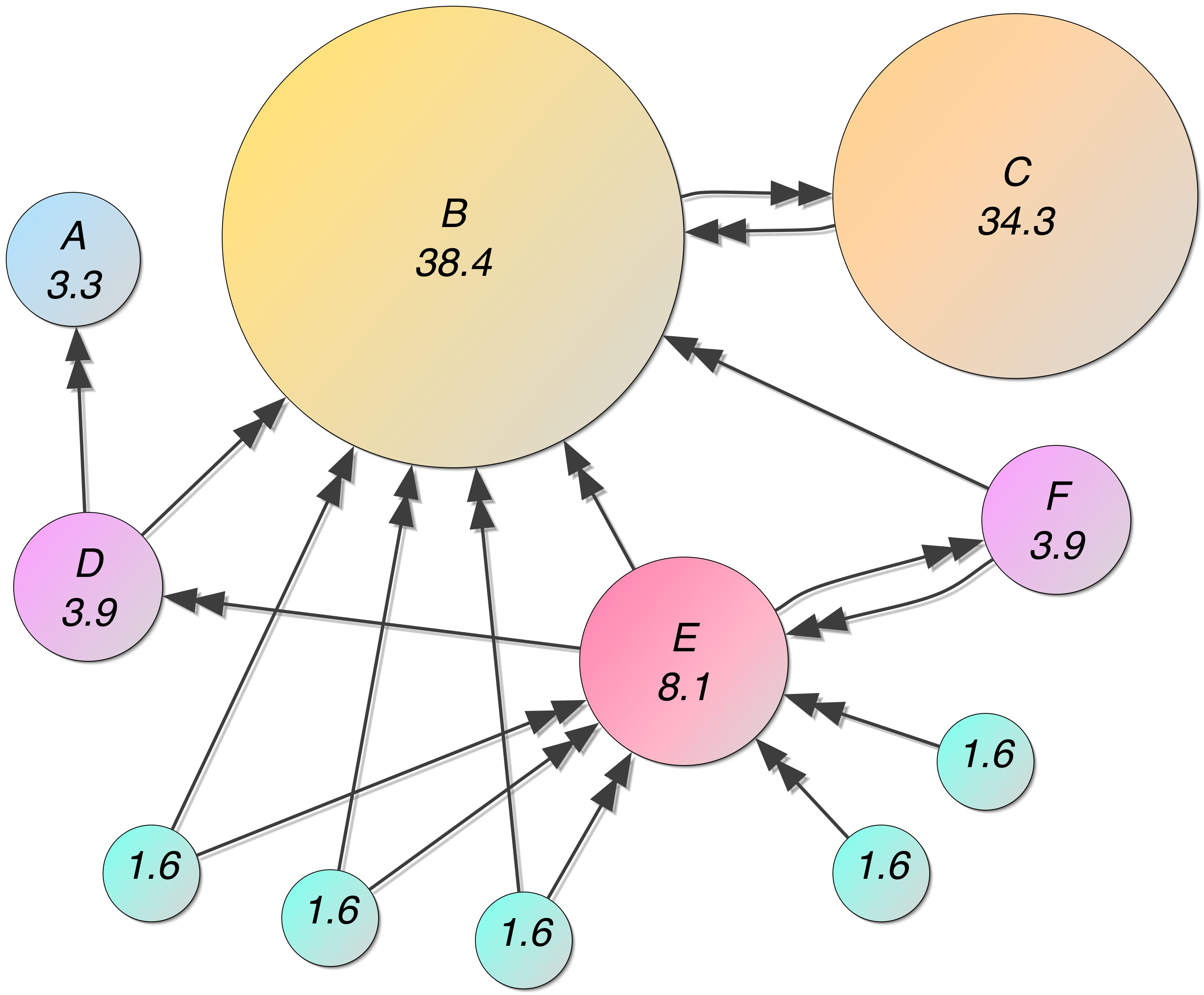
The PageRanks for an example network are shown below. Page C has a higher PageRank than Page E, even though it has fewer incoming links. This is because the one link to C comes from Page B, which is itself an important page.
(from https://en.wikipedia.org/wiki/PageRank)
16.4.1. The PageRank Algorithm#
We can model the entire web as a massive, sparse, directed graph where each web page is a vertex and each hyperlink is an edge.
16.4.1.1. The “Random Surfer” Model#
PageRank is best understood through the “random surfer” model. Imagine a person randomly clicking links on the web. The PageRank of a page \(i\), \(PR(i)\), is the probability that this random surfer will be on page \(i\) at any given moment.
A surfer on a page \(j\) can do one of two things:
With probability \(d\) (the damping factor, usually ~0.85), they click a random link on that page. If page \(j\) has \(L(j)\) outgoing links, they will land on page \(i\) (where \(j \to i\)) with probability \(d \cdot \frac{PR(j)}{L(j)}\).
With probability \(1-d\), they get bored and “teleport” to any random page on the web, landing on page \(i\) with probability \(\frac{1-d}{N}\), where \(N\) is the total number of pages.
16.4.1.2. The Power Iteration#
Combining these two ideas gives the PageRank equation for a page \(i\):
This is a massive system of linear equations! But we can solve it easily using the power iteration method. We start with an initial guess for the PageRank vector \(R\) (e.g., \(R_i = 1/N\) for all \(i\)) and then iteratively update it using the formula above until it converges.
We can write this update in matrix form:
Where:
\(R\) is the \(N \times 1\) vector of PageRanks.
\(\mathbf{1}\) is an \(N \times 1\) vector of all ones.
\(M\) is the \(N \times N\) sparse transition matrix. \(M_{ij} = 1/L(j)\) if there is a link from \(j\) to \(i\), and 0 otherwise. This is the transpose of the (normalized) adjacency matrix!
16.4.1.3. Creating the Adjacency Matrix#
Let’s compute the PageRank for the graph shown above. First, we build the \(N \times N\) adjacency matrix \(A\), where \(A_{ij}=1\) if there is an edge from \(i\) to \(j\). We build this using the COO-to-CSC constructor.
using Plots, SparseArrays, LinearAlgebra # Load all required packages
# Define the edges (from -> to)
rows_i = [2,3,4,4,5,5,5,6,6,7,7,8,8,9,9,10,11] # 'from' vertex (row index)
cols_j = [3,2,1,2,2,4,6,2,5,2,5,2,5,2,5,5,5]   # 'to' vertex (col index)

# Create the 6x6 adjacency matrix A (A_ij = 1 if i -> j)
A = sparse(rows_i, cols_j, 1, 11, 11)

# Get L(i), the number of *outbound* links for each page i
# We sum across the columns (dims=2) for each row
L = sum(A, dims=2)[:]

# Handle "Dangling Nodes" (pages with no outbound links)
# If a page has no links (L[i]==0), the surfer gets trapped.
# We fix this by pretending it links to *all* pages (including itself).
# This means A[i,:] = 1, and L[i] will be N (which is 6).
A[L.==0, :] .= 1

# Display the 'fixed' adjacency matrix
spy(A, markersize=8, title="Spy Plot of Adjacency Matrix (A)")

16.4.1.4. The PageRank Function#
Now we implement the power iteration. The key step is creating the transition matrix \(M\).
We can get \(M\) (where \(M_{ij} = 1/L(j)\) if \(j \to i\)) by first normalizing \(A\) (so \(A_{ij} = 1/L(i)\) if \(i \to j\)) and then taking the transpose.
function pagerank(A, d=0.85, tol=1e-8)
    # Get N, the number of pages (A is NxN)
    N = size(A, 2)

    # Recalculate L, the out-degree vector (since A might have been fixed)
    L = sum(A, dims=2)

    # Create the column-stochastic transition matrix M
    # 1. (A ./ L) normalizes each row i by its out-degree L(i)
    #    (A ./ L)_ij = 1/L(i) if i -> j
    # 2. (...) ' takes the transpose.
    #    M_ji = 1/L(i) if i -> j. This is exactly M_ij = 1/L(j) if j -> i.
    M = (A ./ L)'

    # Start with an initial guess: uniform PageRank
    R = ones(N) / N

    # Iterate until convergence
    while true
        # The PageRank update formula!
        newR = d * (M * R) .+ (1 - d) / N

        # Check if the change is smaller than our tolerance
        if maximum(abs.(newR - R)) < tol
            return newR # Converged!
        end

        R = newR # Update for next iteration
    end
end
pagerank (generic function with 3 methods)
Finally, we can compute and display the PageRanks for our example network.
# Run the PageRank algorithm on our adjacency matrix A
ranks = pagerank(A)
round.(100ranks, digits=1) # Show percentages
11-element Vector{Float64}:
  3.3
 38.4
 34.3
  3.9
  8.1
  3.9
  1.6
  1.6
  1.6
  1.6
  1.6