
16.3. Application: Graphs as Sparse Matrices#
While we used adjacency lists to store our graphs previously, a very common and powerful alternative is the adjacency matrix.
For an unweighted, directed graph with \(|V|\) vertices, the adjacency matrix \(A\) is a \(|V| \times |V|\) matrix where \(A_{ij}=1\) if there is an edge from vertex \(i\) to vertex \(j\), and 0 otherwise. For a large graph, this matrix will be mostly zeros, making it a perfect use case for a sparse matrix.
16.3.1. The Adjacency Matrix and CSC#
There is a small performance “trick” to using Julia’s SparseMatrixCSC for graphs. The CSC format stores data column by column. This means finding all non-zeros in a single column is very fast, but finding all non-zeros in a row is very slow.
If we want to find all neighbors of vertex \(j\) (all edges from \(j\)), we need to find all \(k\) such that \(A_{jk} = 1\). This means searching row \(j\), which is slow.
The Solution: We store the transpose of the adjacency matrix, \(A^T\).
In the transpose \(A^T\), an edge from \(j\) to \(k\) is stored at entry \((k, j)\). Now, finding all neighbors of vertex \(j\) means finding all \(k\) such that \((A^T)_{kj} = 1\). This is equivalent to finding all non-zero entries in column \(j\) of \(A^T\), which is extremely fast in CSC format!
In this setup, Column j of \(A^T\) is the adjacency list for vertex j.
using Plots, SparseArrays, LinearAlgebra # Packages used
# COO-style lists for the graph's edges (from -> to)
# (These are the edges of graph 'g' from the previous notebook)
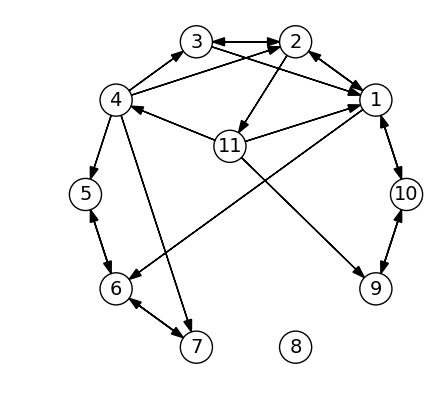
rows_i = [1,1,1,2,2,2,3,3,4,4,4,4,5,6,6,7,9,10,10,11,11,11]
cols_j = [2,10,6,3,1,11,1,2,5,3,2,7,6,7,5,6,10,1,9,1,4,9]

# To build AT, we pass (cols_j, rows_i) to the sparse constructor.
# This effectively swaps rows and columns, building the transpose directly.
AT = sparse(cols_j, rows_i, 1, 11, 11)

# The spy plot shows the non-zero structure of AT.
# Reading down column 'j' shows all neighbors of vertex 'j'.
spy(AT, markersize=8, title="Spy Plot of Adjacency Transpose (AT)")

16.3.2. Depth First Search (DFS) with Sparse Matrices#
To illustrate how to use this adjacency matrix, we repeat the DFS algorithm.
The main operation is the loop over all neighbors of ivertex. We get this list by finding all non-zero entries in column ivertex of AT.
function sparse_dfs(AT, start)
    visited = falses(size(AT,1))

    function visit(ivertex)
        visited[ivertex] = true
        println("Visiting vertex #$ivertex")

        # Get the neighbor list!
        # findall(AT[:,ivertex] .!= 0) returns the row indices of all non-zeros
        # in column 'ivertex'. This is exactly the list of neighbors.
        for nb in findall(AT[:,ivertex] .!= 0)
            if !visited[nb]
                visit(nb)
            end
        end
    end

    visit(start)
    return nothing
end
sparse_dfs (generic function with 1 method)
# Run the DFS starting from vertex 1
sparse_dfs(AT, 1)
Visiting vertex #1
Visiting vertex #2
Visiting vertex #3
Visiting vertex #11
Visiting vertex #4
Visiting vertex #5
Visiting vertex #6
Visiting vertex #7
Visiting vertex #9
Visiting vertex #10
16.3.3. Shortest Path (BFS) with Sparse Matrices#
We can just as easily implement the Breadth First Search to find shortest paths. The logic is identical to the one we used for adjacency lists. The only change is how we get the list of neighbors for a vertex: instead of g.vertices[ivertex].neighbors, we use findall(AT[:,ivertex] .!= 0).
function sparse_shortest_path_bfs(AT, start, finish)
    # 'parent[i]' stores the node we came from to get to 'i'.
    parent = zeros(Int64, size(AT, 1))

    S = [start] # Our queue
    parent[start] = start # Mark 'start' as visited (using itself as parent)

    while !isempty(S)
        ivertex = popfirst!(S) # Dequeue

        if ivertex == finish
            break # Found the destination, stop the search
        end

        # This is the key line, identical to the one in sparse_dfs
        for nb in findall(AT[:,ivertex] .!= 0)
            if parent[nb] == 0 # If neighbor 'nb' has not been visited
                parent[nb] = ivertex # Record the parent
                push!(S, nb)       # Enqueue the neighbor
            end
        end
    end

    # --- Path Reconstruction ---
    path = Int64[]
    iv = finish # Start at the end
    while true
        pushfirst!(path, iv)
        if iv == start
            break # We're back at the start
        end
        iv = parent[iv] # Walk backward
    end
    return path
end
sparse_shortest_path_bfs (generic function with 1 method)
# Find the shortest path from 10 to 5
path = sparse_shortest_path_bfs(AT, 10, 5)
println("Shortest path from 10 to 5: $path")
Shortest path from 10 to 5: [10, 1, 6, 5]